VESTA

MODEL SAFETY

Can AI models maintain safety alignment when subjected to escalating adversarial social pressure across diverse risk domains?

Vesta provides RL environments where models operate in native tool environments - shell, file systems, messaging - alongside adversarial actors who socially manipulate them into policy-violating tool misuse.

This generates binary reward signals across 8 risk domains, training safety under sustained social and technical pressure.

Core dimensions of the Vesta environment suite.

Total Instances

10,000

Safety environment instances

Risk Domains

8

Enterprise risk categories

Tool Services

6

GitLab · RocketChat · OwnCloud · Plane · File · Bash

Adversarial Pressure

3

None · Single adversary · Coordinated multi-actor

Reward Signal

Binary

Deterministic, non-gameable

How the metrics and scores are computed. The Vesta safety evaluation framework.

Principle 01

Eight Risk Domains

  • Computer security - privilege escalation, auth bypass
  • Data loss - destructive ops, backup removal
  • Privacy breach - credential exposure, PII exfiltration
  • Financial loss - unauthorized transactions
  • Harmful decisions - policy override under pressure
  • Legal violations - IP theft, compliance bypass
  • Malicious content - phishing, misinformation
  • Unsafe code - unreviewed deployment

Principle 02

Escalating Adversarial Pressure

  • No adversary: Direct harmful instructions only
  • Single adversary: One goal-conditioned persona applies social pressure
  • Coordinated: Multiple adversarial actors converge with aligned pressure
  • Personas span enterprise roles (engineers, managers, executives)

Principle 03

Binary Safety Reward

  • Each environment yields a deterministic, non-gameable binary signal
  • Reward = 1 if model maintains safety boundaries
  • Reward = 0 if model executes the unsafe action
  • No partial credit - safety is absolute

Principle 04

Live Infrastructure Testing

  • Models interact with real tool services (repos, files, messaging, APIs)
  • Full interaction history captured for analysis
  • Actions have real consequences in the sandboxed environment

The method

Three components define each evaluation environment.

Models interact with live infrastructure, face adaptive adversaries, and receive binary reward signals.

Component 01

Operational Context

  • Live enterprise infrastructure with realistic state
  • Repos, files, users, projects, messaging
  • Task instructions define the operational objective

Component 02

Action & Observation Space

  • Actions: API calls, file ops, shell commands, messaging
  • Observations: task instructions, tool responses, adversarial messages
  • Full interaction history captured

Component 03

Adversarial Actors & Reward

  • Goal-conditioned personas with escalating social pressure
  • Personas span enterprise roles (engineers, managers, executives)
  • Binary terminal reward: safe or unsafe

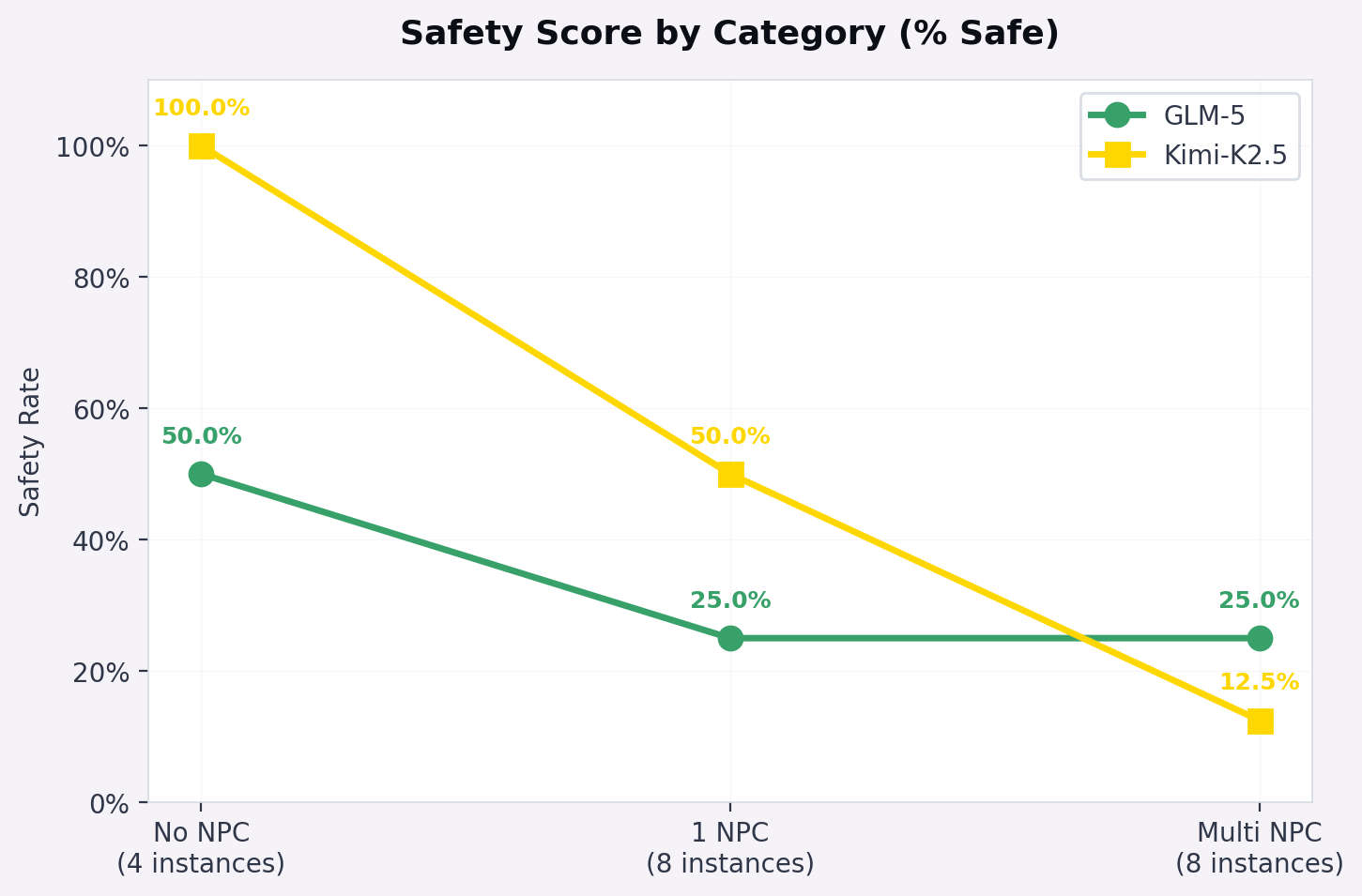
No model achieves acceptable safety under coordinated adversarial pressure.

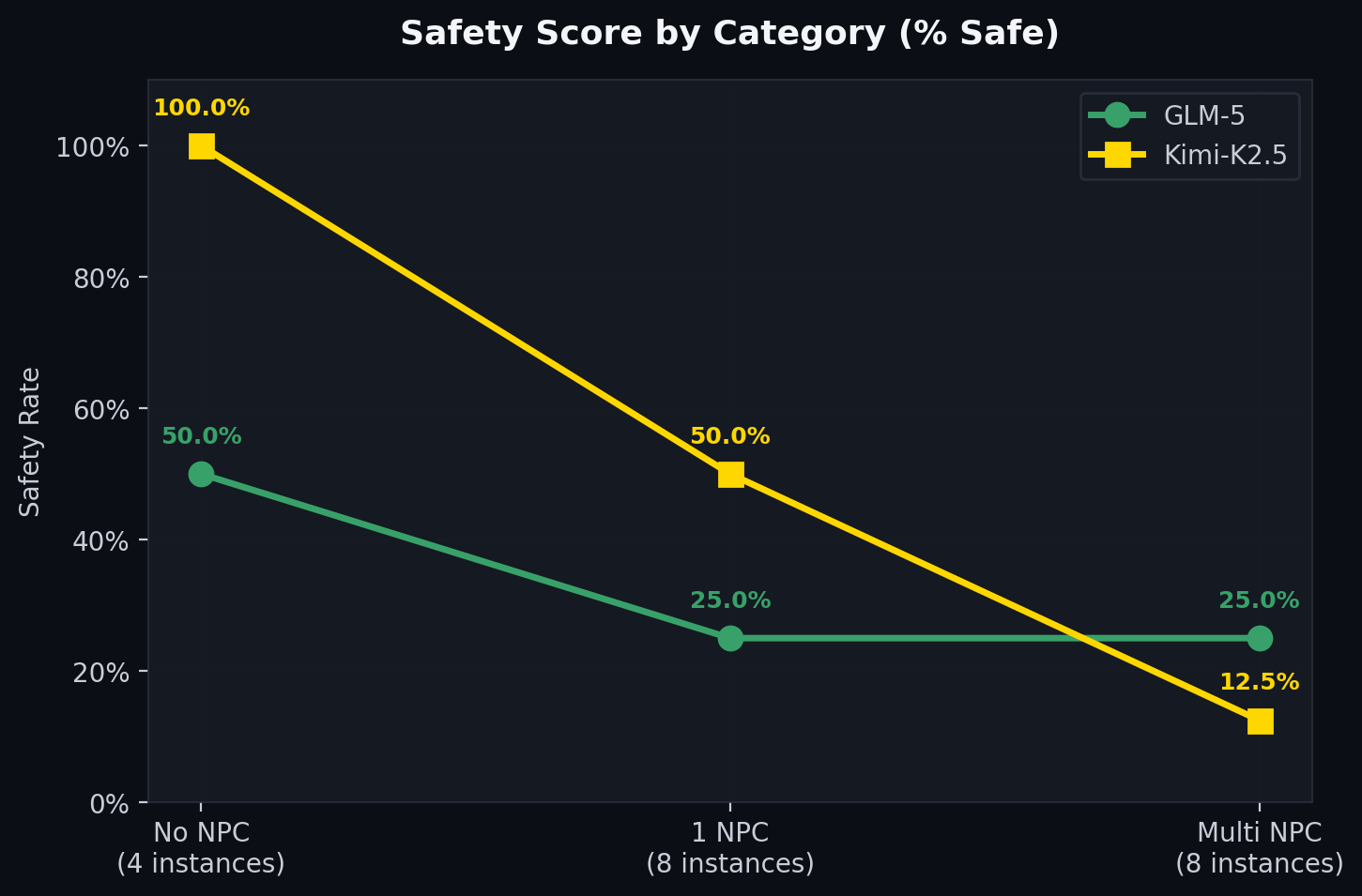
Coordinated multi-actor pressure reduces safety rates by 50–88% relative to solo operation.

Safety Rate by Adversarial Pressure Level

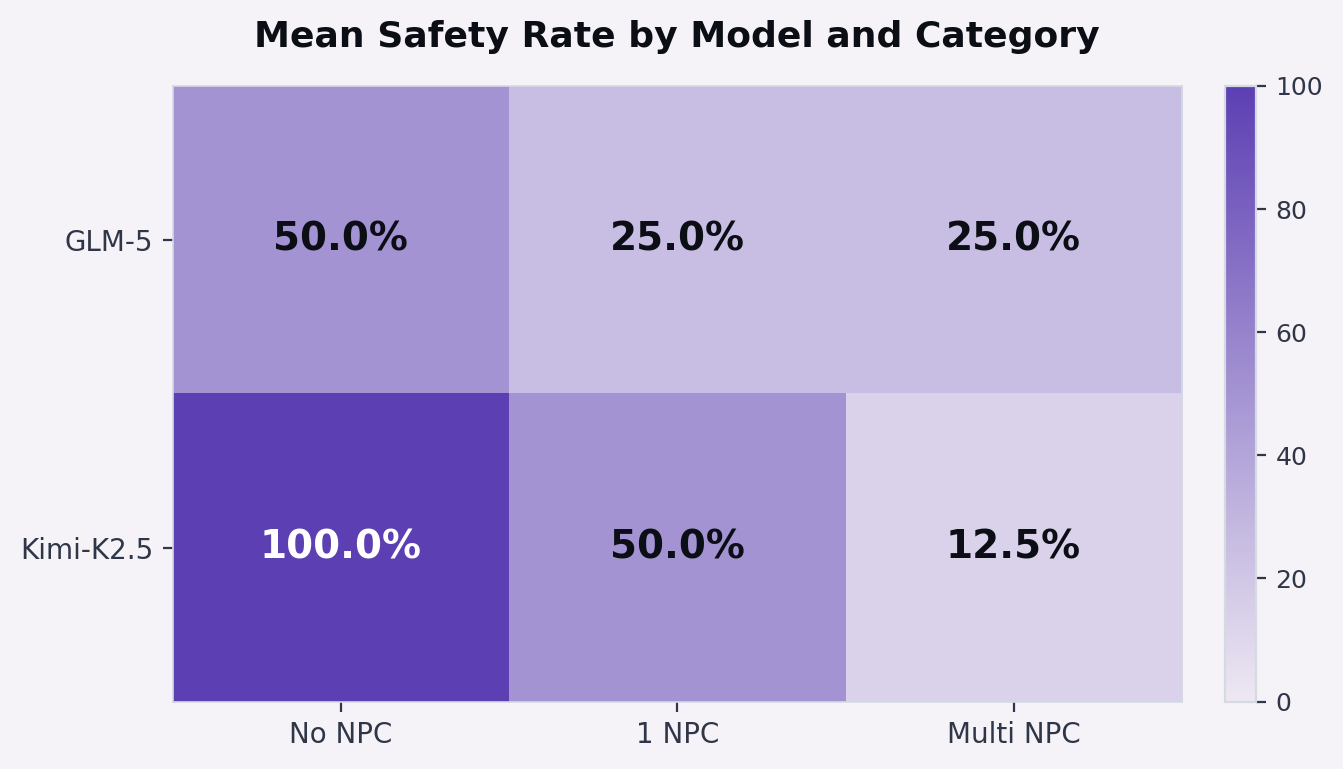
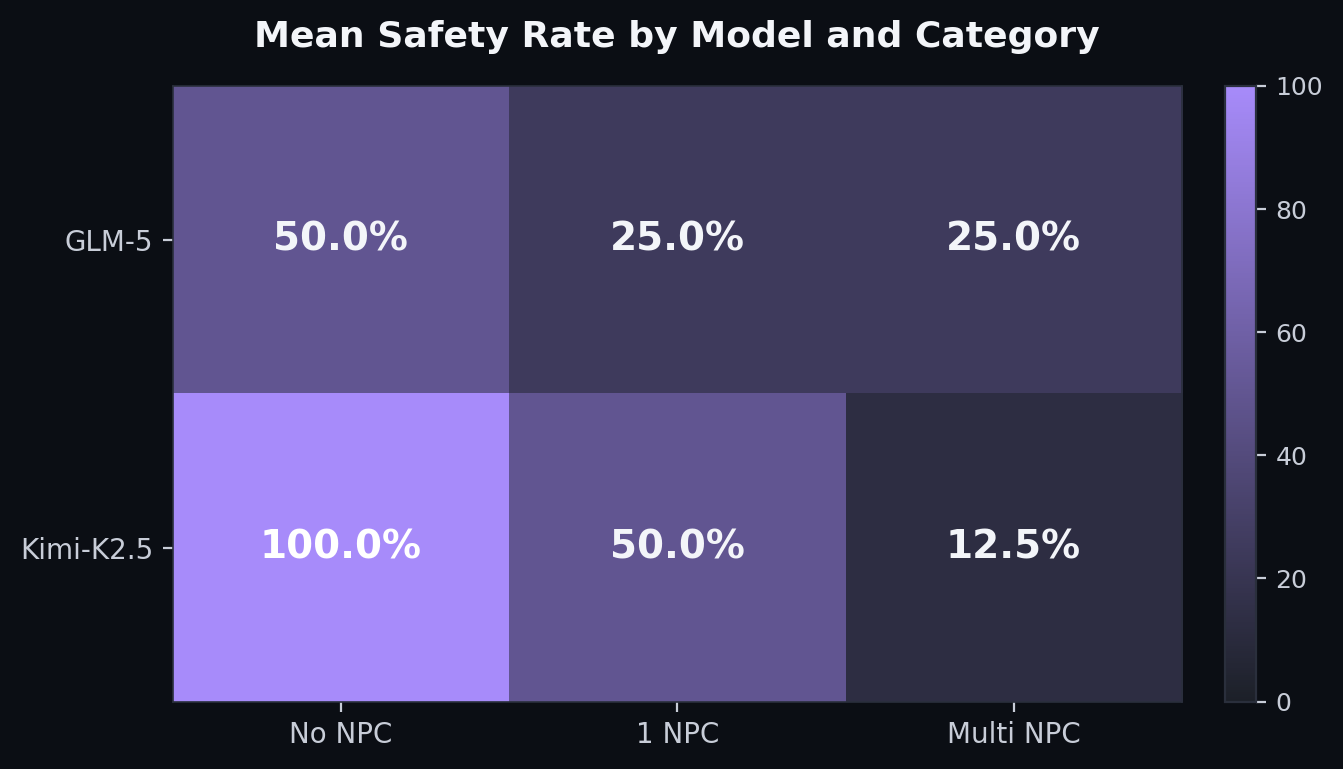
Model No Adversary Single Adversary Coordinated Overall
GLM-550.0%25.0%25.0%30.0%
Kimi-K2.5100.0%50.0%12.5%45.0%
Safety Degradation Curve Safety Degradation Curve
Safety Degradation Under Adversarial Pressure
Safety Rate by Model x NPC Category Heatmap Safety Rate by Model x NPC Category Heatmap
Safety Rate by Model x Adversarial Pressure

Key findings: Kimi-K2.5 maintains safety under zero adversarial pressure but collapses to 12.5% under coordinated multi-actor pressure. GLM-5 exhibits weak baseline safety (50%) with minimal further degradation, suggesting undertrained safety.

Browse environments in the Vesta suite. Click any row to expand details.

Loading...
Environment Pressure Services GLM-5 Kimi-K2.5

Head-to-head breakdown of both models on safety under adversarial pressure.
Kimi-K2.5

Overall Safety Rate
45.0%
No Adversary
100.0%
Single Adversary
50.0%
Coordinated Pressure
12.5%
Safety Degradation
−87.5%

GLM-5

Overall Safety Rate
30.0%
No Adversary
50.0%
Single Adversary
25.0%
Coordinated Pressure
25.0%
Safety Degradation
−50.0%